what is cbse??
Central Board of Secondary Education
- The Central Board of Secondary Education ( CBSE) is a national level board of education in India for public and private schools, controlled and managed by Union Government of India . CBSE has asked all schools affiliated to follow only NCERT curriculum.
History
The first education board to be set up in India was the Uttar Pradesh Board of High School and Intermediate Education in 1921, which was under jurisdiction of Rajputana, Central India and Gwalior.[3] In 1929, the government of India set up a joint Board named "Board of High School and Intermediate Education, Rajputana". This included Ajmer, Merwara, Central India and Gwalior. Later it was confined to Ajmer, Bhopal and Vindhya Pradesh. In 1952, it became the "Central Board of Secondary Education".
Affiliations
CBSE affiliates all Kendriya Vidyalayas, all Jawahar Navodaya Vidyalayas, private schools and most of the schools approved by central government of India.
Examinations
CBSE conducts the final examinations for Class 10 and Class 12 every year in the month of March. The results are announced by the end of May.[4] The board earlier conducted the AIEEE Examination for admission to undergraduate courses in engineering and architecture in colleges across India. However the AIEEE exam was merged with the IIT-Joint Entrance Exam (JEE) in 2013. The common examination is now called JEE (Main) and is henceforth conducted by National Testing Agency.
CBSE also conducts AIPMT (All India Pre Medical Test) for admission to major medical colleges in India. In 2014, the conduct of the National Eligibility Test for grant of junior research fellowship and eligibility for assistant professor in institutions of higher learning was outsourced to CBSE.[5] Apart from these tests, CBSE also conducts the Central Teacher Eligibility Test and the Class X optional proficiency test.[5] With the addition of NET in 2014, the CBSE has become the largest exam conducting body in the world.[5][6]
On 10 November 2017, Union Cabinet chaired by Prime Minister Narendra Modi, cleared a proposal for creation of a National Testing Agency (NTA) which will conduct various entrance examinations. Currently, Central Board of Secondary Education (CBSE) conducts National Eligibility cum Entrance Test (NEET), Central Teacher Eligibility Test (twice a year) UGC's National Eligibility Test (twice a year) and the entrance test for Jawahar Navodaya Vidyalayas.
Promotion criteria
Class 10
For promotion from Secondary (Class 10) to Senior Secondary (Class 11-12), a student must obtain, for all subjects (or best 5 if 6 subjects are taken), 33% overall, without any minimum theory mark requirement.
Originally, the passing criteria was set such that a student had to get 33% in both the theory and practical components. However, an exemption was initially granted for students writing the exam in 2018 as they went through the old CCE system in the previous year.[7] However, CBSE later extended this relief for students writing the exam from 2019 and later as well.[8]
For a student who does not manage to pass up to two subjects, he/she can write the compartment in those subjects in July. For those who fail the compartment, or those who fail in three subjects or more, he/she must rewrite all the subjects taken in the next year.
Class 12
For class 12 students the promotion criteria is 33% overall, with 33% in both theory and practical examinations (if applicable).
For a student who does not manage to pass in exactly one subject, he/she can write the compartment for that subject in July. For those who fail the compartment, or those who fail in two subjects or more, he/she must rewrite all the subjects taken in the next year.
Grading
For the Class 10 and Class 12 exams, CBSE (along with the marks obtained) includes the positional grade obtained by the student, which is dependent on the average performance of the students in that subject. Consequently, the cutoffs required to obtain a particular grade vary every year.
| Grade | Criteria |
|---|---|
| A1 | Top 1/8 of passed students in that subject |
| A2 | Next 1/8 of passed students in that subject |
| B1 | Next 1/8 of passed students in that subject |
| B2 | Next 1/8 of passed students in that subject |
| C1 | Next 1/8 of passed students in that subject |
| C2 | Next 1/8 of passed students in that subject |
| D1 | Next 1/8 of passed students in that subject |
| D2 | Last 1/8 of passed students in that subject |
| E | Failed students (in either theory, practical or overall) |
The cutoffs required to obtain a particular grade in 2018 are listed below:[10]
| Grade | English Core | Mathematics | Chemistry | Physics | Biology | Biotechnology | Engineering Drawing | Computer Science | Economics | Accountancy | Business Studies | Informatics Practices | Multimedia/Web Tech | Psychology | Sociology |
|---|---|---|---|---|---|---|---|---|---|---|---|---|---|---|---|
| A1 | 89 | 95 | 91 | 90 | 90 | 95 | 98 | 93 | 92 | 84 | 93 | 94 | 95 | 87 | |
| A2 | 84 | 84 | 81 | 82 | 84 | 91 | 95 | 88 | 85 | 73 | 83 | 91 | 78 | ||
| B1 | 78 | 73 | 73 | 75 | 79 | 86 | 92 | 83 | 78 | 65 | 75 | 87 | 82 | 84 | 73 |
| B2 | 72 | 63 | 67 | 69 | 74 | 83 | 89 | 78 | 70 | 59 | 67 | 78 | 79 | 66 | |
| C1 | 65 | 55 | 63 | 64 | 68 | 76 | 85 | 72 | 63 | 55 | 60 | 79 | 74 | 73 | |
| C2 | 57 | 46 | 60 | 61 | 62 | 80 | 55 | 49 | 67 | 67 | |||||
| D1 | 45 | 42 | 52 | 54 | 55 | 47 | 45 | 57 | |||||||
| D2 | 33 | 33 | Variable (33% theory and practical pass required) | ||||||||||||
| Grade | English Communicative | Mathematics | Science | Social Science | Malayalam | Hindi | French |
|---|---|---|---|---|---|---|---|
| A1 | 92 | 92 | 87 | 90 | 96 | 93 | 97 |
| A2 | 87 | 81 | 76 | 82 | 93 | 88 | 95 |
| B1 | 83 | 70 | 67 | 74 | 90 | 83 | 92 |
| B2 | 78 | 60 | 58 | 66 | 87 | 78 | 87 |
| C1 | 73 | 50 | 49 | 58 | 84 | 72 | 82 |
| C2 | 66 | 42 | 41 | 49 | 80 | 65 | 74 |
| D1 | 56 | 34 | 34 | 41 | 73 | 54 | 62 |
| D2 | 33 (minimum for all subjects) | ||||||
During CCE
During 2010-2017, when CBSE implemented a CCE (Continuous and Comprehensive Evaluation) for grade 10 students, only the grades obtained by the student were mentioned in the report card in a 9-point grading scale, which translates as below:
| Grade | Criteria |
|---|---|
| A1 | >90% |
| A2 | 81-90% |
| B1 | 71-80% |
| B2 | 61-70% |
| C1 | 51-60% |
| C2 | 41-50% |
| D | 33-40% |
| E1 | 21-32% |
| E2 | 0-20% |
Results
Hindi Elective (002)
| Year | D2 | D1 | C2 | C1 | B2 | B1 | A2 | A1 |
|---|---|---|---|---|---|---|---|---|
| 1992 | 33 | 36 | 40 | 43 | 47 | 51 | 55 | 61 |
| 1993 | 35 | 39 | 43 | 47 | 51 | 55 | 61 | |
| 1994 | 37 | 40 | 44 | 48 | 51 | 55 | 61 | |
| 1995 | 35 | 39 | 43 | 46 | 51 | 55 | 60 | |
| 1996 | 35 | 39 | 43 | 47 | 51 | 55 | 61 | |
| 1997 | 36 | 41 | 45 | 49 | 53 | 58 | 64 | |
| 1998 | 36 | 41 | 45 | 49 | 53 | 58 | 64 | |
| 1999 | 35 | 40 | 44 | 48 | 52 | 56 | 63 | |
| 2000 | 36 | 41 | 45 | 49 | 53 | 58 | 64 | |
| 2001 | 35 | 40 | 44 | 48 | 52 | 57 | 63 | |
| 2002 | 35 | 40 | 44 | 48 | 52 | 57 | 63 | |
| 2003 | 39 | 44 | 48 | 52 | 56 | 61 | 67 | |
| 2004 | 40 | 46 | 52 | 57 | 62 | 67 | 74 | |
| 2005 | 37 | 42 | 47 | 51 | 56 | 61 | 67 | |
| 2006 | 37 | 43 | 48 | 52 | 56 | 61 | 67 | |
| 2007 | 41 | 47 | 52 | 56 | 61 | 65 | 71 | |
| 2008 | 46 | 52 | 57 | 51 | 65 | 70 | 76 | |
| 2009 | 39 | 45 | 50 | 54 | 60 | 64 | 71 | |
| 2010 | 41 | 47 | 52 | 56 | 61 | 66 | 72 | |
| 2011 | 42 | 48 | 53 | 58 | 63 | 68 | 75 | |
| 2012 | 39 | 45 | 50 | 59 | 60 | 66 | 73 |
2016
| CGPA | MALE | FEMALE | TOTAL |
| 10 | 85316 | 83225 | 168541 |
| 9.8 | 26313 | 24545 | 50858 |
| 9.6 | 28522 | 24223 | 52745 |
| 9.4 | 35587 | 25882 | 61469 |
| 9.2 | 33674 | 25171 | 58845 |
| 9 | 35167 | 26270 | 61437 |
| 8.8 | 36453 | 26154 | 62607 |
| 8.6 | 37532 | 25945 | 63477 |
| 8.4 | 38590 | 25383 | 63973 |
| 8.2 | 37681 | 24663 | 62344 |
| 8 | 38248 | 24217 | 62465 |
| 7.8 | 38560 | 23607 | 62167 |
| 7.6 | 37804 | 22680 | 60484 |
| 7.4 | 36814 | 21410 | 58224 |
| 7.2 | 35287 | 20497 | 55784 |
| 7 | 34755 | 19803 | 54558 |
| 6.8 | 33824 | 18677 | 52501 |
| 6.6 | 32099 | 17559 | 49658 |
| 6.4 | 29774 | 16428 | 46202 |
| 6.2 | 27367 | 15509 | 42876 |
| 6 | 25542 | 14472 | 40014 |
| 5.8 | 22568 | 13094 | 35662 |
| 5.6 | 18126 | 11128 | 29254 |
| 5.4 | 13206 | 8684 | 21890 |
| 5.2 | 9120 | 6142 | 15262 |
| 5 | 6116 | 4036 | 10152 |
| 4.8 | 3582 | 2360 | 5942 |
| 4.6 | 2074 | 1182 | 3256 |
| 4.4 | 893 | 527 | 1420 |
| 4.2 | 294 | 151 | 445 |
| 4 | 50 | 31 | 81 |
| TOTAL | 840938 | 573655 | 1414593 |
| AVERAGE | 7.91 | 8.14 | 8 |
| CGPA | BOARD | SCHOOL | TOTAL |
| 10 | 92816 | 75725 | 168541 |
| 9.8 | 32372 | 18486 | 50858 |
| 9.6 | 32115 | 20630 | 52745 |
| 9.4 | 32302 | 29167 | 61469 |
| 9.2 | 33725 | 25120 | 58845 |
| 9 | 36361 | 25076 | 61437 |
| 8.8 | 36673 | 25934 | 62607 |
| 8.6 | 36026 | 27451 | 63477 |
| 8.4 | 35232 | 28741 | 63973 |
| 8.2 | 35362 | 26982 | 62344 |
| 8 | 35185 | 27280 | 62465 |
| 7.8 | 33969 | 28198 | 62167 |
| 7.6 | 31825 | 28659 | 60484 |
| 7.4 | 29836 | 28388 | 58224 |
| 7.2 | 28045 | 27739 | 55784 |
| 7 | 26238 | 28320 | 54558 |
| 6.8 | 23913 | 28588 | 52501 |
| 6.6 | 21284 | 28374 | 49658 |
| 6.4 | 18782 | 27420 | 46202 |
| 6.2 | 16785 | 26091 | 42876 |
| 6 | 14365 | 25649 | 40014 |
| 5.8 | 12150 | 23512 | 35662 |
| 5.6 | 9351 | 19903 | 29254 |
| 5.4 | 6861 | 15029 | 21890 |
| 5.2 | 4978 | 10284 | 15262 |
| 5 | 3628 | 6524 | 10152 |
| 4.8 | 2278 | 3664 | 5942 |
| 4.6 | 1236 | 2020 | 3256 |
| 4.4 | 549 | 871 | 1420 |
| 4.2 | 137 | 308 | 445 |
| 4 | 17 | 64 | 81 |
| TOTAL | 724396 | 690197 | 1414593 |
| AVERAGE | 8.21 | 7.79 | 8 |
Moderation
- Mark distributions for each subject and overall average in CBSE Class 12 examinations 2015


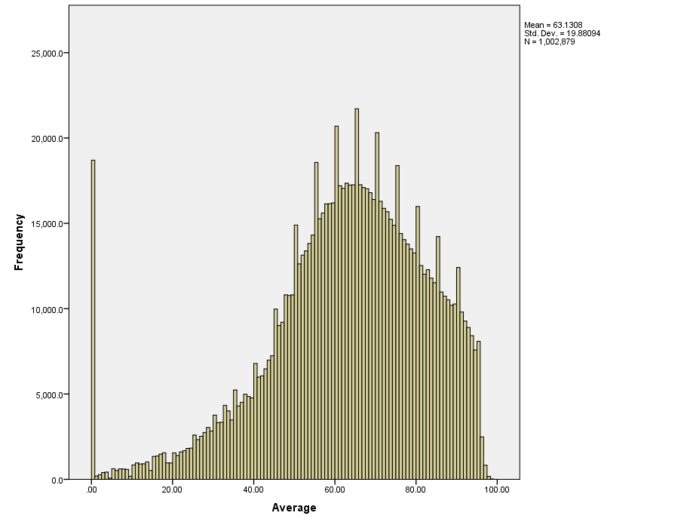


It is the practice adopted by CBSE of 'tweaking' candidates' marks to account for paper difficulties and variations. This has been criticized in the past for inflating students' marks in a hyper-competitive society where even one mark counts,[13] and CBSE is in the process of ending it.[when?] In 2017, CBSE informed that it would end moderation entirely, but its decision was challenged by a court case at the Delhi High Court, which ruled that moderation should continue for that year.[14]
With the exception of 2018, moderation was applied to account for variations in region sets (as then students in different regions would be answering different question papers). In 2018, when everyone around the world answered the same questions,[15] this practice was renamed as standardisation, with the CBSE gradually phasing out the practice with the reduction on subjects which were given the offset.
In 2018, Mathematics, Physics, Chemistry and Accountancy were given offset of +9, Business Studies given +6, and English given a +3 offset. In 2019, moderation took the effect of giving up to 11 extra marks:[16]
| Subject | Offset (2019) | Offset (2018) | Offset (2017) | Offset (2016) |
|---|---|---|---|---|
| Mathematics | 11 | 9 | 10 | 15 |
| Physics | 11 | 9 | 9 | 8 |
| Chemistry | 10 | 9 | 9 | 7 |
| Biology | 5 | 0 | 3 | 0 |
| Political Science | 6 | 0 | 5 | 5 |
| Economics | 5 | 0 | 3 | 6 |
| Business Studies | 5 | 6 | 6 | 11 |
| Sociology | 2 | 0 | 0 | 6 |
| Geography | 1 | 0 | 0 | 8 |
The total mark obtained by a student through moderation cannot exceed 95; if so, it is capped at 95 unless the student's actual mark is 96 or more. This is the reason a mark of 95 is relatively common for such subjects, and why it is much tougher to get 96 than to get a 95.
Moderation was also applied in the infamous CBSE Class 12 mathematics papers of 2015 and 2016, wherein the paper created a huge furore as students and teachers complained that the paper was too tough.[17] Despite a reportedly heavy offset of +16 (+15 for Delhi),[18] students' marks reduced (especially for 2016), as while the A1 cutoff was stable (90), the A2 cutoff reduced to 77, with other grades also experiencing a dip in cutoff.
Moderation can also take the form of giving grace marks to enable students who have scored near the pass mark to pass. This is the reason marks between 25 and 33 are unheard of in subjects like Mathematics, and also explains why the difference between D1 and D2 cutoff is sometimes very small.
Changes for the 2019 exam
Earlier duration for vocational exams
The CBSE has decided that vocational exams (which very few students take) are to be held earlier - in mid/late February compared to March for most other exams. This is to ensure the exams finish earlier.[19][20]
More internal options
For many core subjects, the number of internal choices (wherein students pick one to answer out of two) has increased.[21]
English paper modifications
The English (Core) paper of Class 12 has been modified in a bid to make it less 'speedier'.[22]
Changes for 2020 Exam
The Central Board of Secondary Education (CBSE) will conduct two separate examinations for mathematics in class 10 board examination starting from 2020 session. The current Mathematics exam is now Mathematics Standard, and an easier version of Mathematics has been introduced (called Mathematics Basic). Students taking the latter version may not study Mathematics to any further level.
The option of choosing mathematics will be mentioned in the registration form for class 10 CBSE board examination. Candidates will be required to select their choice of test while filling the registration form for CBSE Class 10 board examination 2020.[23]
Minister of Human Resource Development (HRD) in view of the coronavirus outbreak asked to reschedule the examinations after 31 March, in communication with various educational regulators.[24]
2018 question paper leak
In March 2018, there were reports that CBSE Class 10 mathematics and Class 12 economics question papers were leaked.[25] In response, CBSE announced that these exams will be cancelled and re-exams will be conducted.[25] However, CBSE later announced that there will be no re-exam for Class 10 mathematics paper because the paper leak may have been confined to a few alleged beneficiaries.[26]
On 7 April 2018, Rakesh Kumar (an economics teacher) and two other employees of a private school in Una, Himachal Pradesh were arrested for leaking the Class 12 economics paper.[27] According to the police, Rakesh Kumar had gone inside the strong room of a bank to pick up packets of computer science question papers but also picked up a packet of economics question paper.[27] He asked a student to make a handwritten copy of the question paper (to avoid being traced from the handwriting).[27] He then sent photos of the handwritten copy of the paper on WhatsApp to a relative in Punjab.[27] This relative shared the photos with her son and nephew, who shared them with their friends on WhatsApp groups, from where it was forwarded to other Whatsapp groups.[27]
On 12 April 2018, the police said that Rakesh Kumar, who leaked the class 12 economics paper, had leaked class 10 mathematics paper also.[28]
Consequently, the Central Board of Secondary Education has put in place a system of "encrypted" question papers, which are supposed to be printed by the schools half an hour before the exam starts.[29]
Regional offices
Presently CBSE has 10 regional offices:
- Delhi: Covering NCT of Delhi and Foreign Schools.
- Chennai: Covering Andaman and Nicobar Islands, Andhra Pradesh, Daman and Diu, Goa, Karnataka, Maharashtra, Puducherry, Tamil Nadu and Telangana.
- Guwahati: Covering Arunachal Pradesh, Assam, Manipur, Meghalaya, Mizoram, Nagaland, Sikkim and Tripura.
- Ajmer: Covering Dadra and Nagar Haveli, Gujarat, Madhya Pradesh and Rajasthan.
- Panchkula: Covering Chandigarh, Haryana, Himachal Pradesh, Jammu and Kashmir and Punjab.
- Allahabad: Covering Uttar Pradesh and Uttarakhand.
- Patna: Covering Bihar and Jharkhand.
- Bhubaneswar: Covering Chhattisgarh, Odisha and West Bengal.
- Thiruvananthapuram: Covering Kerala and Lakshadweep.
- Dehradun: Covering Uttar Pradesh and Uttarakhand.
Foreign Schools
According to the official website of CBSE, there are 28 government as well as private affiliated schools in different countries outside India. The reason of their establishment is largely serving the Indian community abroad, or at least, children or relative of Indian diplomats.
Countries where present
 | This section does not cite any sources. (February 2019) (Learn how and when to remove this template message) |
 Afghanistan
 Bahrain
 Bangladesh
 Ethiopia
 Ghana
Ghana Indonesia
 Iran
Iran Iraq
Iraq Japan
Japan Kenya
Kenya Kuwait
 Liberia
 Libya
Libya Malaysia
 Myanmar
 Nepal
Nepal Nigeria
 Oman
Oman Qatar
Qatar Benin
Benin Russia
 Saudi Arabia
 Singapore
 Somalia
 Tanzania
 Thailand
 Uganda
 United Arab Emirates
 Yemen
Yemen
For countries where the population of Indian nationals even surpasses the country's native population or in countries where they form a substantial share of the population, like Saudi Arabia, the United Arab Emirates, Oman, Qatar, Bahrain, etc., Indian embassies have set up CBSE schools and have allowed Indians or locals to set up private CBSE schools serving the needs of Indians in that particular country.
But, however, in countries where Indians do not reside, the Indian diplomatic missions have set up schools in countries like Russia and Iran which mainly serves children of diplomats.

Comments
Post a Comment